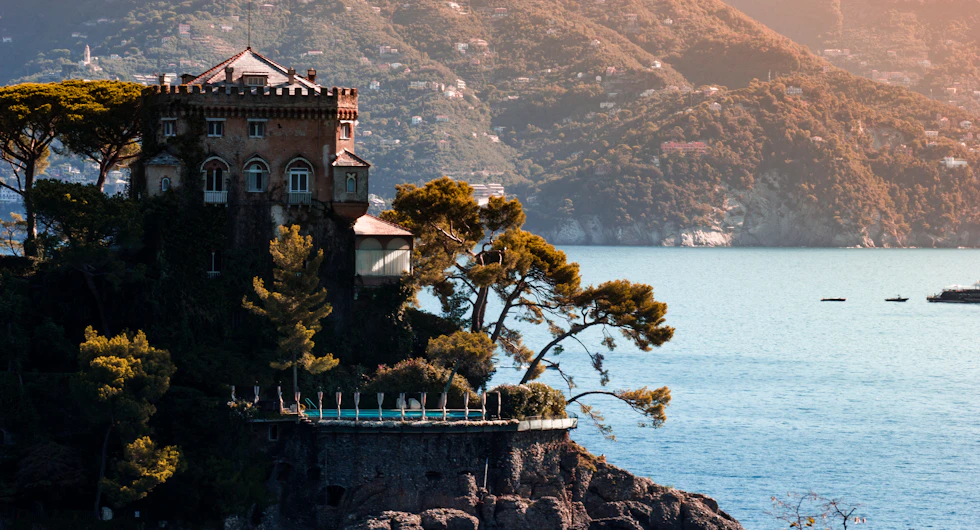
If you’ve searched for hidden places Alassio, you’ve probably seen the same shortlist repeated across dozens of articles. The same beach clubs, the same celebrity references, the same polished promenade photographs. This guide goes in a different direction. These are the quieter corners locals still mention to friends over aperitivo, the hill villages people return to in late afternoon light, and the churches and coastal spots that sit slightly outside the standard Italian Riviera circuit.
10 Hidden Places Around Alassio You Won’t Find in Any Travel Guide
1. The Sanctuary of Nostra Signora della Guardia
The sanctuary sits high on Monte Tirasso above the bay, where the scent of pine and dry herbs replaces the salt air below. It dates to the 17th century and stands on the site of the medieval castrum Tiraculi. From the churchyard you can see across Alassio, Gallinara Island and the curve of the Riviera di Ponente. Go in the early evening when the hills cool and the light turns silver over the sea.
2. Sant’Anna ai Monti
Sant’Anna ai Monti feels older than most visitors expect from Alassio. The small church stands along the former Roman road linking Alassio with Albenga, and parts of the structure date back to the early 9th century. There is very little spectacle here, which is exactly the point. Stone walls, quiet olive terraces and the muffled sound of cicadas make it feel far removed from the busy lungomare (the seafront promenade).
3. Gallinara Island
Gallinara Island is visible from almost every open terrace along this stretch of coast, yet relatively few people engage with its history. The island is a protected nature reserve with Roman and Phoenician relics and an underwater statue of the Virgin Mary visited by divers. Boat trips operate offshore, though the atmosphere remains quieter than the larger Riviera excursions. On clear mornings the sea shifts from dark cobalt to pale green around the rocks.
4. The Church of Sant’Ambrogio
Many people walk past the Church of Sant’Ambrogio without fully stepping inside. Built on 10th-century foundations, it combines a Romanesque-Gothic bell tower with a richly decorated Baroque interior. The cobbled churchyard stays cool even in midsummer, whilst the interior smells faintly of candle wax and old stone. It remains one of the defining monuments of Alassio without ever becoming over-explained.
5. The English Library
The English Library tells a less obvious story about Alassio. In the late 1800s and early 1900s, British winter visitors shaped part of the town’s social life, and the library remains from that period. It has a quieter atmosphere than the cafés around the centre. You notice the wooden shelves first, then the filtered afternoon light coming through the windows facing the palms and gardens nearby.
6. Moglio d’Alassio
Moglio d’Alassio sits inland from the coast and often escapes mainstream coverage because it lacks a single headline attraction. What it offers instead is perspective. The roads narrow, laundry moves lightly between balconies, and you hear church bells carrying across the hills above Alassio. If the seafront feels crowded in August, Moglio gives you a more residential rhythm within the wider municipality.
7. Zuccarello
Zuccarello changes the pace entirely. The medieval village inland from Alassio centres around covered walkways, stone façades and the remains of a 13th-century castle. Even in summer, the air tends to feel cooler here than on the coast. You smell wood smoke from kitchens in colder months and rosemary from hillside gardens in warmer weather. It works best as a slow afternoon rather than a checklist stop.
8. Castelvecchio di Rocca Barbena
Castelvecchio di Rocca Barbena sits close to Zuccarello but receives even less attention. The village climbs around its medieval structure in steep layers of stone passages and shaded corners. There are moments where you hear only footsteps and distant swallows overhead. It appeals particularly to people looking for an off-the-beaten-path Liguria experience that still feels lived-in rather than curated for tourism.
9. Cervo
Cervo is not unknown, but it remains strangely absent from many Alassio itineraries despite being a short journey west along the coast. The Baroque Church of San Giovanni Battista, often called dei Corallini, rises above the sea with pale stone and soft ochre tones catching the late sun. Small caruggi (the medieval alleys) lead between 16th-century palaces where you catch flashes of blue water at the end of narrow passages.
10. Laigueglia
Laigueglia is technically next door to Alassio, yet many visitors never move beyond the main shopping streets and bagni (the beach clubs). The older fishing-village atmosphere survives around the church square and seafront lanes. Chiesa di San Matteo, with its twin bell towers topped by majolica domes, anchors the town visually. Early morning is the best time to walk here, when you can smell espresso and warm focaccia drifting out onto the quiet streets.
These are the places that give the area its texture beyond the familiar postcard version of Alassio. None are literally secret spots on the Italian Riviera, but they resist the heavy repetition of mainstream travel lists. During a longer stay at the villa, these quieter corners often become the places families remember most clearly.