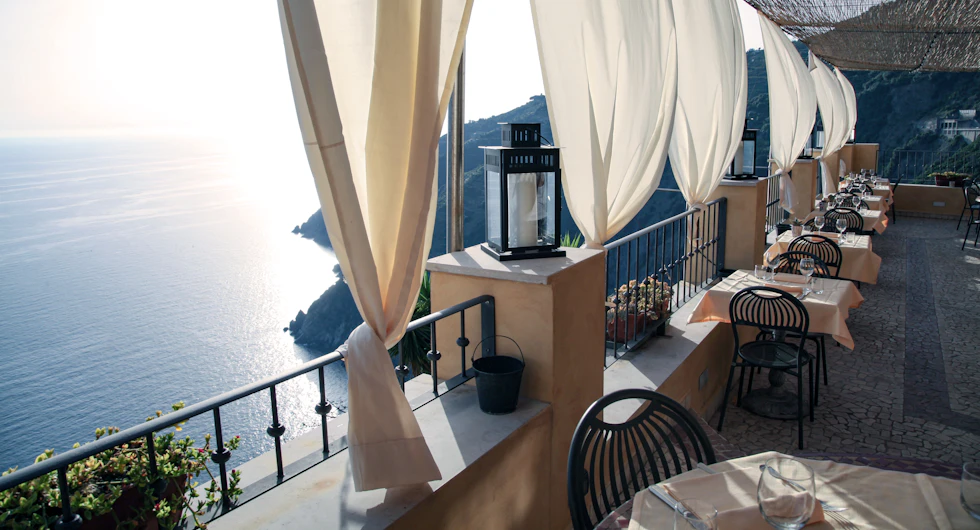
In the western stretch of Liguria, the hills arrive at the sea almost without warning. Olive groves, pines, and apartment buildings give way to steep terraces cut into stone. These narrow strips of vineyard, known locally as fasce, run above the Riviera di Ponente in lines so tight that nearly all the work still happens by hand. Early in the morning around Alassio, the air carries sea salt from the bay and the smell of warm focaccia from cafés opening along the lungomare, the seafront promenade. It is a landscape shaped as much by geography as by agriculture, and that matters when you begin to understand the wines made here.
Liguria does not compete with Tuscany or Piedmont in scale, nor does it try to. With roughly 1,475 hectares under vine, it is among the smallest wine regions in Italy. The region has eight DOC appellations and four IGPs, but no DOCG. Even within Italy, many drinkers know Liguria more readily for pesto, anchovies, and summer beaches than for wine. Yet that narrowness of terrain, squeezed between mountains and sea, gives the Riviera di Ponente a very specific style of white wine: saline, bright, herbal, and naturally suited to the food of the coast.
Liguria’s coastal wines and the quieter character of the Riviera di Ponente
The western Riviera, stretching from Arenzano towards the French border, sits within the Riviera Ligure di Ponente DOC. Alassio lies close to its centre. Here the vineyards climb quickly away from the shoreline, often above 300 metres, where evening temperatures cool even after hot summer days. The sea moderates extremes, but altitude preserves acidity and freshness. That combination explains why Ligurian whites rarely feel heavy, even in warmer years.
Wine in Liguria often appears in small contexts rather than grand ones. A glass of Pigato with fried anchovies near the harbour. Vermentino poured beside trofie with pesto. Rossese opened slowly over dinner whilst the evening passeggiata moves through the old streets. Guests staying in private villas around Alassio often notice this quickly. The wines are integrated into ordinary meals and seasonal rhythms rather than treated as collector objects. Restaurants along the coast rarely need to persuade locals to order Ligurian bottles; the pairing logic is already understood.
Pigato is perhaps the clearest example of this regional identity. The grape is indigenous to Liguria and cultivated almost exclusively in the provinces of Savona, Imperia, and Genoa. DNA research has confirmed it is genetically identical to Vermentino, yet in practice the wines can feel quite different. Pigato tends to flourish at higher elevations, especially above 300 metres, where cooler nights sharpen its structure. The name comes from the freckles or spots that appear on the grape skins as they ripen.
In the glass, Pigato often carries notes associated with Mediterranean herbs and a distinctly saline edge, sometimes finishing with a slight almond bitterness. Those flavours vary considerably between producers and vineyard sites, which matters in a region built on fragmented terraces rather than broad plains. Around Albenga, west of Alassio, Pigato has become particularly associated with the inland slopes where sea air still reaches the vines. The wines make immediate sense beside Ligurian cooking because the cuisine shares the same herbal and coastal character: marjoram, olive oil, pine nuts, anchovies, and delicate seafood broths rather than rich sauces.
Vermentino appears across much of the western Mediterranean, especially in Sardinia and parts of Tuscany, but the Ligurian expression is noticeably more restrained than many warmer examples further south. It is also Liguria’s most widely planted grape. Along the Riviera di Ponente, Vermentino usually leans towards citrus and saline freshness rather than overt richness. Even where tropical fruit notes appear, the wines tend to finish dry and coastal in character.
That distinction matters because Liguria’s wine culture depends less on power than on balance at the table. Local meals are rarely structured around heavy tannins or concentrated sauces. Instead, there are stuffed vegetables, octopus salads, grilled fish, and farinata fresh from the oven. Vermentino works because it follows the same rhythm as the food. The wines refresh rather than dominate. In warmer months, particularly by late spring and early summer, that style feels especially aligned with the pace of the coast, when outdoor lunches stretch into the afternoon and aperitivo begins before sunset.
Although the whites define much of Liguria’s reputation, the region’s reds deserve attention for similar reasons. Rossese di Dolceacqua DOC, established in 1972 as Liguria’s first DOC, sits near the French border in the Val Nervia and Valle Crosia. Vineyards there climb between 300 and 600 metres across 14 communes. The wines must contain at least 95 per cent Rossese and carry a minimum alcohol level of 12 per cent, rising to 13 per cent for Superiore.
Rossese is sometimes described as the Nebbiolo of Liguria, though the comparison is more useful structurally than stylistically. The wines are typically pale ruby in colour with floral aromas and red fruit rather than deep extraction. Rose, blackberry, and spice appear regularly, but the overall impression remains light-footed. Historical accounts even suggest Napoleon had Rossese sent to Paris, which fits the long cultural overlap between western Liguria and the French Riviera beyond the border.
Further east, beyond the Riviera di Ponente, Liguria also produces one of Italy’s most distinctive sweet wines: Sciacchetrà from the Cinque Terre. The wine is made primarily from Bosco, with smaller amounts of Vermentino and Albarola. After harvest, the grapes are dried on racks for several months before pressing, producing extremely low yields. The resulting passito is rich yet lifted by acidity, traditionally served with pandolce or canestrelli biscuits. It sits apart from the dry coastal whites, but it reflects the same underlying reality of Ligurian viticulture: difficult terraces, small-scale farming, and wines shaped by necessity as much as by fashion.
What becomes clear after time in Liguria is that the wines belong to the landscape in a practical sense. The steep fasce prevent industrial farming. The sea moderates the climate. The cuisine evolved around olive oil, herbs, vegetables, and fish because that is what the terrain allowed. Importing heavier styles from elsewhere would miss the point entirely. Pigato beside salted anchovies or Vermentino with shellfish feels less like pairing theory and more like continuity between land, coast, and table.
For travellers spending time around Alassio and the Riviera di Ponente, these wines offer a useful way into the region itself. They are not designed for spectacle, and that is partly why they remain memorable. The pleasure comes from context: sea air moving through hillside vineyards, café shutters opening in the morning, and a bottle that fits naturally into the rhythm of the coast rather than trying to stand apart from it.